
A Third Language
“That I and you can be things, standing understood, among each other. One word can be a poem believe it, one word can destroy a poem dare I.” Layli Long Soldier, Whereas

“Compulsory education in America compels accommodation to exclusively White forms of ‘English.’ White English, in America, is ‘Standard English.”
June Jordan, Nobody Mean More to Me Than You and the Future Life of Willie Jordan
“Writing the dead, I refuse mastery. I give myself to them, I disappear with them, I learn how to be mortal with them.”
Cristina Rivera Garza, Los muertos indóciles / “On the Necro‑Ethics of Disappropriation”
“Palestine and all the struggles with which it is bound up require of us, in any and all forms of speech going forward, a commitment to constant and escalating betrayals of this machine. It requires that we poison and betray Craft at all turns.”
Fargo Tbakhi, Notes on Craft: Writing in the Hour of Genocide
A Third Language
To write about writing is my favorite way to knot the mind. To write about writing is like crying into river; to join the land vessels that water always finds and remembers. If you consider these typed marks as what gathers to swell at the banks of your attention, you might listen for a certain familiar rhythm in the cadence of my wondering, which may further bring us together now across distances and varied prayers, which may return us to each other like water returns to itself. What forces rise and flow among and between this text to make us possible, together?
It is there/here where I meet you now.
In The Classroom
I’m in my 8th year of teaching English, Composition, Poetry, and Reading Practices in various institutions and unaffiliated communities of practice. And even though every season, many students sigh their relief at entering their last English class ever, I still learn something extraordinary about language through and alongside, even the most apathetic of students.
A couple of years ago a local student movement for Palestine taught me that true questioning, in this case about who has the right to violence, makes war-mongering universities shake with fear. Students taking ownership of their own education exposes the control over narratives that institutions are barely holding onto.
Students shaping language in solidarity with global struggles through independent research, grassroots pedagogies, and self-made learning spaces is a dangerous, powerful thing. Students demanding that truth not be demeaned or degraded are recreating the potential for autonomous education and causing the university to expose the true nature of their stakes in learning: protecting empire‘s projection of power.
I’m excited about the way language moves and lives within the evasive vernaculars of young people’s lives because I am currently growing from the possibilities these languages make tangible in cultivating consciousness.
At the community college where I teach, a lot of the students are multilingual, come from mixed-status homes, and encounter English as a subject to overcome on their way to a sensible career or trade. And yet, their linguistic lives recreate and evolve processes of communal possibility and aliveness that resist certain systems of control specific to their regions and circumstances. As they approach the world of higher education, they encounter yet another attempt at smothering the embers of their spirit.
I lesson plan and build rapport with students while the classroom bursts with our individual and collective tensions inside the field of meaning. We set out to acquire English and Composition skills and often begin with or fall into a search for sophistication, for a credit or a grade, for fulfilling often volatile expectations.
But we also discover a deeply situated voice, a thing inherited and tied to our rooted embodiments, one that I can’t help but sense that we risk abandoning for the sake of scholastic or standarized legibility.
What we end up saying or writing seldom embodies fully the maze of being that it takes to culminate in a thing said or written. Yet still, I believe the effort to express and the courage to be wrong guide us into conversations that help us not only learn or remember but also become.
When we get honest, together, about the stories and words we carry with us, we are called to the deeper waters of our lives in a way that makes us attentive to the circumstances that insist on a superficial existence– an existence that will not work for us anymore.
Developing individual and communal writing practices alongside students has become my main goal. And trying to enact it has laid clear the stakes of making meaning; how literacy is a site of power and empire unless we break open study as a refusal to adhere simply.
We must acknowledge and wield literacy as a way to see ourselves, to name ourselves, to name the violence we are both complicit and incapacitated by, and to resist these. We must learn to listen, to notice, and to understand the stakes of our knowledge keeping/sharing.
This type of literacy which I am enacting now as I sit in my living room at the day’s hottest hour, with turquoise curtains shutting out the sun, my baby in the next room with her father, babbling, this type of literacy where I am recalling and typing phonetic symbols to the thoughts occurring in my brain so that you may be able to read them, this type of literacy where I am thinking of you and me and the text as the space where we meet, this type of literacy is informed by other practices like oral storytelling, praying, singing, and dancing; a humanness that is handed down and rediscovered.
This type of literacy is explicitly taught. And because it is taught, whether intentionally or not, language becomes a window through which we can see our undeniable purpose in all children’s lives: to accompany them as they gain stories, relations, and purpose. As Mills, Combs, and Kelly say in their article Sensing place: Embodiment, sensoriality, kinesis, and children behind the camera, “ Literacy practices do not occur only in the mind, but involve the sensorality, embodiment, co-presence, and movement of bodies”(11).
And so, we do feel, especially within the chambers of academia, the influence empires and cultures have on the choices we make when building a sentence. All of it is intentional. Even and especially so our performances, our deviations, our mistakes, and our “failures.”
It is our collective failure that shows us how writing can be, must be, almost always becomes, and unbecomes, a communal undoing. Consider the bits of stories and myths you cling to alongside others. Where do you disappear, only to then emerge? Where do we speak most unabashedly, most confidently? What if these are the sites of power we have been looking for? Maybe our collective attentions and tensions, our collective heads turning toward a certain way of speaking, a certain tale or song, a certain memory about what really happened, a certain question, a certain reverence, a certain force– maybe there is a power here. Could we structure a literacy that steps outside the debris of standards and is alive without the notions of what it ought to be?
Literazine
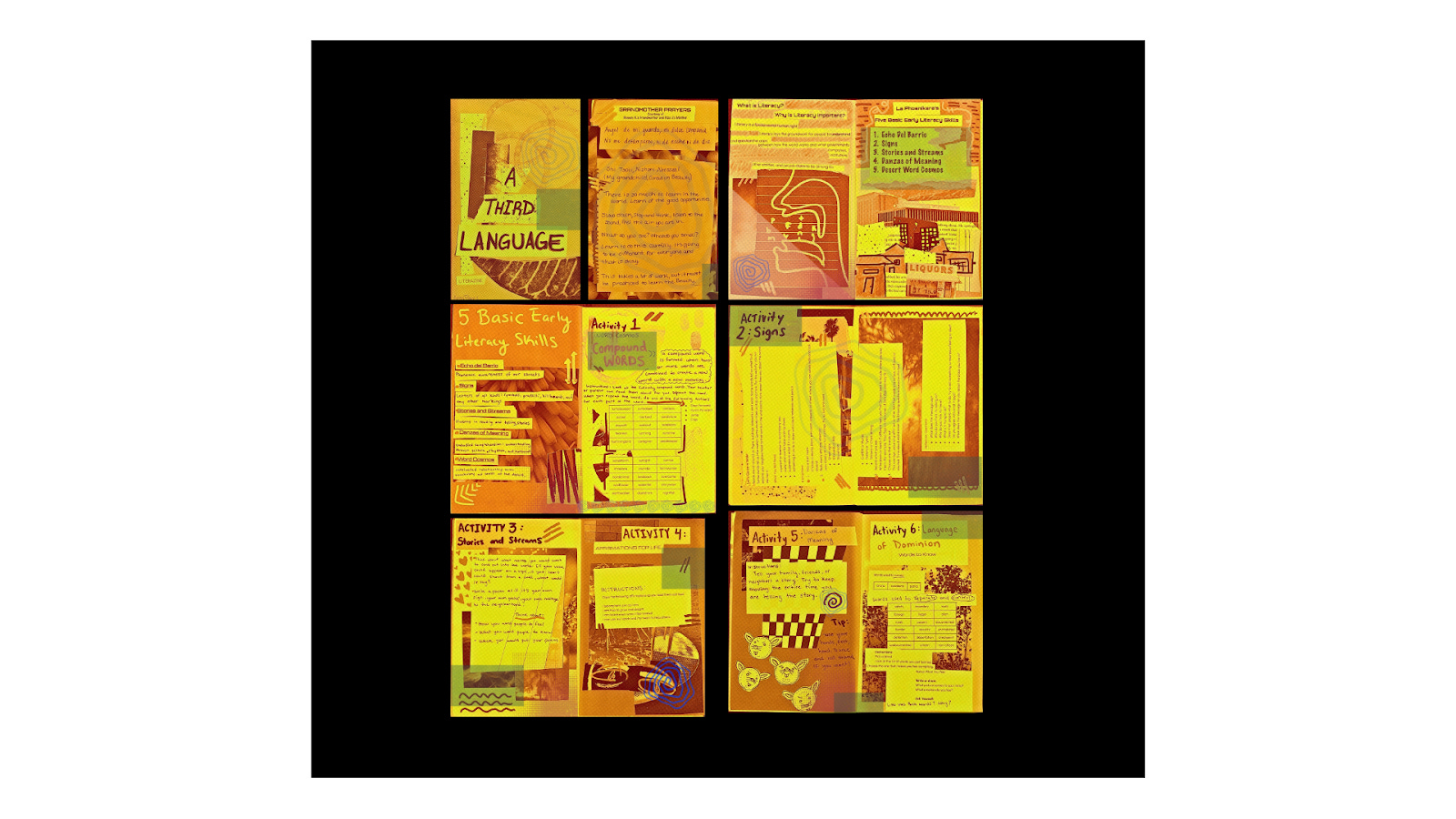
I wrote A Third Language: Literazine to synthesize these questions and the endless hopes I have about making meaning. Too many students come to the ENG 101 classroom devoid of any confidence or investment in their literacy skills. In initial narrative-building essays, they talk earnestly about the precise moments in their childhood, when a teacher or other adult convinced them that they were a “bad writer” or “bad reader.” No doubt these conclusions are drawn by report cards, standardized tests, and other institutionalized markers of success and failure meant to separate us into those worth higher education and those not. Those worth more language and those not.
There is real grief in students as they bear the brunt of their literary abandonment and rhetorical disparagement. To convince a child that their words, their insights, their attentions are somehow broken or inefficient is a diagnosis that can only happen in a world sick with a delusion of a particular story told in a particular way.
And what happens when a young person goes quiet? We lose. We lose out on so, so much.
On AI
English Language Learners have long used automated tools like Google Translate, Grammar assistants, and more to support their academic efforts. ChatGPT is not so much a departure from existing practices, but rather an extension of them, especially within an educational landscape that continues to prioritize mindless productivity over the students’ growth in their writing practice.
Both with peers and with students and with myself, I have grappled with the way LLMs speed up composition or research or perhaps make it easier to formulate. And still, I am not convinced that their use actually equips us with better skills or even capacity in composition, especially when “making things easier is the oft-stated claim of an industry that privileges products over processes”(Paris). When I have used ChatGPT, I am left with a feeling of emptiness, a void in the operation of working through thoughts and life.
Professor Lucinda McKnight of Deakin University says, “There isn’t currently any ethical way to use these tools. We know they are trained on a stolen corpus of materials…”(11). That and the fact that corporate interests collect, “information about people’s practices, preferences, musical tastes, and interests”(Leander, 12) PLUS the exploited labor and exploited land behind this billion dollar industry returns me this question:
What am I willing to give up, offer, abandon, degrade, and kill in the name of ease, speed, and productivity? And I’m not only thinking of underpaid workers and the two glasses of water it takes to consult ChatGPT, I’m thinking too about the loss of the communal creative process, of our sensitivities, and writing with one another. It’s clear to me that these consequences to people, land, and our relations are inextricable.
Daniel Saldaña París says in his article Translation, AI, and the Political Weight of Words, “When AI replaces community and its forums, it also disempowers their political potential.”
As for students, academic writing is often already performative, shaped by the class-influenced deadlines of external expectations and institutional structures. AI only intensifies these pressures, as policies struggle to keep pace with the technology while avoiding seeing students, seeing children, and listening to them.
What’s at stake in a student’s literacy journey is not just credits or grades. It is their sense of origin, identity, belonging, allegiance, and participation as political and relational subjects.
I’ve seen that, for a lot of young people, real meaning making happens in the most illegible parts of their lives where they form true connections to themselves and to the world around them. The languages that surface here are robust, flexible, and free from capture. It’s this language that is barred from making it into our “research essays” and other scholarly genres. This system of control messes with the potential for liberatory influence that we could have on one another.
To Study Literacy
I feel disgusted and bored at the context of recurring, expected, and circular strategies the United States Government employs to keep children from education and from literacy. Reading and writing are pivotal tools for our current and future communities to thrive, to see themselves, to see each other. At the same time, I remain wary about the standards that dictate what successful literacy even looks like in the classroom, especially when administration is more and more willing to automate the process of writing for both student and educator.
I come to the study of literacy not as an expert, but as a multilingual and translingual pocha and poet and an obsessive thinker living in linguistic contradiction. My commitments are shaped by proximity and longing. For years, I’ve written alongside transborder youth in Nogales, AZ, out of a heart obligation and because this border and its sounds, silences, circulations, and constant interrogations are the root of my questions and politic. For years, I’ve visited classrooms, exchanged poems, and stayed close to the everyday speech acts within my border-dwelling family and the networks of survival they occupy, which resist erasure, which resist institutional validation, and which resist being seen for fear of persecution. This is my study.
The biggest lesson I have learned from continuing to write against all odds and criticisms, and misunderstandings, and attacks, and demeaning is that the possibility of surviving demands presence and not only performance or critique from afar.
In 2024, following a sense of play and experimentation, I initiated a literacy project with Nogales youth, part love letter and part theoretical risk. I borrowed a contested speed-reading framework I was taught as an “at-risk” child-student in Maryvale, Phoenix. I was hoping to explore how reading habits might shift under pressure, or play, or competition. But the project didn’t land. It was a bust full of a kind of distracted urgency that now feels like a refusal, on my part, to slow down and actually listen. I failed to protect the context that these young people inhabit, and I underestimated the cultural rigor required to honor it.
Still, this failure taught me more that the literacy I seek will not be legible to everyone because it’s rooted in the resistant, joyful, and often quiet knowledge already living in transborder children and their families who move through translingual and transnational literacies, who move through daily interrogation, and negotiate their belonging through the stories they inherit.
I have new questions now about literacy and about meaning. What can we name? What tries to name us? What words do we take off? What words do we take on? What stories do we keep from the teachers and institutions? What are the true challenges of writing, those not dictated by the standards set by a state or by an educator pressured by that state? When young people upset our expectations, can we find a practice of subversion we can work to support or to protect?
Thinking about the classroom as a space to attempt poetic research always returns me to a strategy of communal writing that sometimes shines a glimpse of true meaning-making for students and me. This is led by prompting questions about where we live, where we come from, who taught us how to sing, what and who we see on our daily commutes, and other modes of situating ourselves and our circumstances.
A Third Language Emerges
Young people, especially young multilingual people, have innate strategies for activation of the potential of language. If we work to encourage these practices, we may be able to help them unmake literary canons so built by imperial legacies that they don’t see themselves in any way. As educators and as adults in spaces with young people and children, we have a distinct opportunity to collaborate (not only in the classroom) toward sustaining ways of meaning and rhetorical purposes that move around, beneath, and against the capitalist war machine of our times.
Literacy is one of the essential pillars of being that we have an utmost duty to protect, maintain, and encourage, especially among our most vulnerable.
June Jordan reminds us:
Children are the ways that the world begins again and again. If you fasten upon that concept of their promise, you will have trouble finding anything more awesome and also anything more extraordinarily exhilarating than the opportunity or/and obligation to nurture a child into his or her own freedom.
This Literazine is dedicated to children and to the child that lives in all of us.
From years of writing poems and performing them and learning alongside students and navigating pedagogical trials and errors, I’m coming to understand how there is a deliberately obscured relationship between our capacity to nurture freedom (both our own and our children’s) and our capacity to recognize, decode, and strategize through language. Freedom from systems of domination is tied to how we access and wield language, how we read the world and ourselves.
I hope this Literazine can encourage conversations between children and adults so that we can come to know ourselves and each other in a sort of third language beyond capture and distance.
References
París, Daniela Saldaña. “La Traducción, La Ia y La Carga Política de Las Palabras.” Asymptote, Cita Press, Sept. 2024, www.asymptotejournal.com/special-feature/translation-ai-and-the-political-weight-of-words-daniel-saldana-paris/spanish/.
Enriquez, Grace, et al. “Generative AI and Composing: An Intergenerational Conversation among Literacy Scholars.” English Teaching : Practice and Critique, vol. 23, no. 1, 2024, pp. 6–22, https://doi.org/10.1108/ETPC-08-2023-0104.
A. Mills, Kathy, et al. “Sensing Place: Embodiment, Sensoriality, Kinesis, and Children behind the Camera.” English Teaching : Practice and Critique, vol. 12, no. 2, 2013, p. 11.